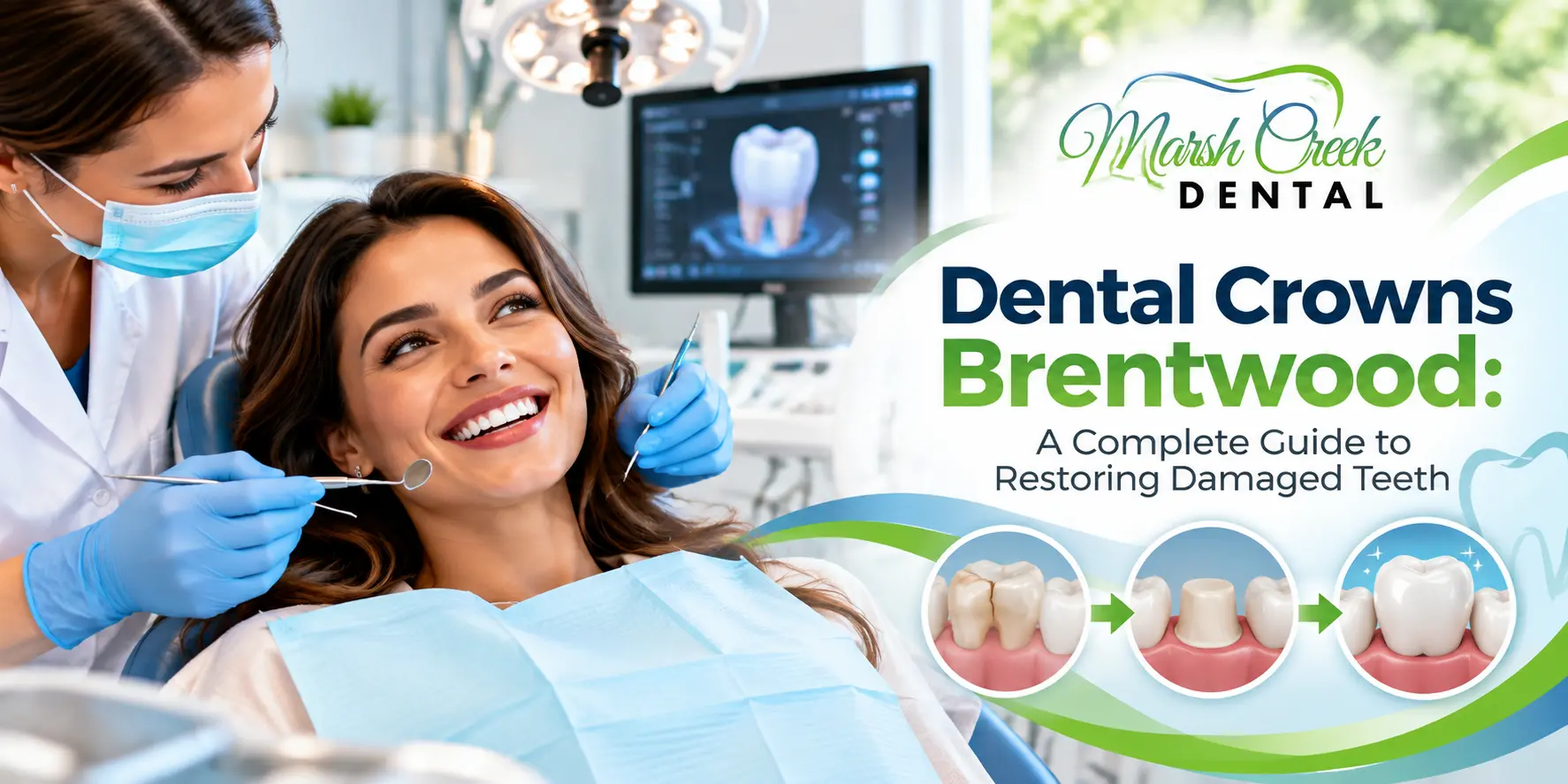
Dental Crowns Brentwood: A Complete Guide to Restoring Damaged Teeth
A damaged, weakened, cracked, or heavily restored tooth may eventually need more protection than a traditional filling can provide. If you have been told that you may need a crown—or if you are searching for dental crowns Brentwood—understanding how dental crowns work can help you make a confident decision about your oral health.
A dental crown is a custom-made restoration that covers a damaged or weakened tooth. It can help restore the tooth’s shape, strength, function, and appearance while allowing you to continue using the tooth normally.
At Marsh Creek Dental, we provide personalized dental crowns and bridges in Brentwood, CA based on the condition of the tooth, your oral health, your bite, and your treatment goals.
But how do you know when a crown is actually necessary? What is the difference between a crown and a filling? How long can a crown last? And what should you expect during the procedure?
This guide answers the most common questions about dental crowns in Brentwood and explains why professional evaluation is an important first step.
What Is a Dental Crown?
A dental crown is a tooth-shaped restoration that fits over a prepared tooth.
Unlike a filling, which restores only a portion of the tooth, a crown covers a larger portion of the visible tooth structure. This can provide additional support when a tooth has been significantly weakened.
Dental crowns may be recommended when a tooth has:
- Extensive decay
- A large existing filling
- Significant structural damage
- A crack or fracture
- Severe wear
- A previous root canal
- A cosmetic concern involving shape or appearance
The purpose of a crown is not simply to make a tooth look better. In many situations, a crown is used to protect the remaining tooth structure and restore normal function.
At Marsh Creek Dental, your dentist can evaluate the condition of your tooth and determine whether a crown, filling, root canal, bridge, or another treatment is more appropriate.
Why Might You Need Dental Crowns in Brentwood?
There are several reasons a dentist may recommend a crown.
Protecting a Weak Tooth
A tooth can become structurally weak after extensive decay, a large filling, trauma, or significant wear.
When too much natural tooth structure has been lost, a filling may not provide enough support.
A crown can cover the remaining tooth and provide additional protection during everyday biting and chewing.
Restoring a Broken Tooth
A cracked or broken tooth may require more than a simple filling, particularly when a substantial amount of tooth structure has been lost.
Depending on the location and severity of the damage, a dental crown may help restore the tooth’s shape and function.
If you experience sudden damage to a tooth, especially after an accident or injury, you may need prompt dental evaluation. Marsh Creek Dental also provides emergency dental care in Brentwood for urgent dental problems.
Supporting a Tooth With a Large Filling
Large fillings can sometimes leave a tooth with limited remaining natural structure.
If a tooth has been repaired multiple times or a filling occupies a significant portion of the tooth, your dentist may determine that additional reinforcement is needed.
In these situations, a crown may provide greater coverage and protection.
Restoring a Tooth After Root Canal Treatment
A tooth that has undergone root canal treatment may require additional protection depending on the amount of remaining tooth structure and the location of the tooth.
Your dentist can evaluate the tooth after root canal therapy and determine whether a crown would help protect it from further damage.
If you have persistent tooth pain or sensitivity and are concerned about a possible infection, learn more about root canal treatment in Brentwood.
Improving the Appearance of a Damaged Tooth
Crowns can sometimes be used for cosmetic purposes when a tooth is severely discolored, misshapen, or damaged.
However, a crown is generally considered a restorative treatment rather than simply a cosmetic procedure.
If your teeth are healthy but your primary concern is cosmetic, other treatments such as professional whitening or veneers may be more appropriate.
Dental Crowns vs. Dental Fillings
One of the most common questions patients have is:
“Do I need a crown, or can I just get a filling?”
The answer depends on how much healthy tooth structure remains.
A filling is typically used to restore a tooth affected by a cavity or relatively limited damage.
A crown may be recommended when the tooth has become too weak or damaged for a filling to provide adequate support.
For example, a small cavity may be successfully restored with a filling. However, if a tooth has extensive decay and only a limited amount of healthy structure remains, placing another large filling may not be the best long-term solution.
The dentist must evaluate the tooth rather than choosing a treatment based only on the size of the cavity.
Marsh Creek Dental also provides dental fillings in Brentwood for appropriate cases.
What Happens During a Dental Crown Procedure?
The exact process can vary depending on the condition of the tooth and the type of restoration being used.
Generally, the process begins with an examination.
Step 1: Dental Examination
Your dentist evaluates the affected tooth and surrounding tissues.
Depending on the situation, dental X-rays may be recommended to assess areas that cannot be seen during a visual examination.
Marsh Creek Dental provides dental X-rays in Brentwood as part of its diagnostic services.
The goal is to understand the condition of the tooth before deciding whether a crown is appropriate.
Step 2: Treatment Planning
Once your dentist understands the condition of the tooth, they can discuss treatment options with you.
Depending on the circumstances, possibilities may include:
- A dental filling
- A dental crown
- Root canal treatment
- Tooth extraction
- A bridge
- An implant-supported restoration
- Another restorative treatment
The best option depends on the amount of healthy tooth structure, the location of the tooth, your bite, your oral health, and your long-term goals.
Step 3: Preparing the Tooth
If a crown is recommended, the tooth is prepared so that the restoration can fit properly.
The amount of preparation depends on the tooth and the restoration.
Your dentist will work to preserve as much healthy natural tooth structure as possible while creating the necessary space for the crown.
Step 4: Creating the Restoration
The crown is designed to fit the shape and function of your tooth.
Factors such as the tooth’s location, bite, appearance, and surrounding teeth can influence the final restoration.
The goal is to create a restoration that functions properly and blends naturally with your smile.
Step 5: Placing the Crown
Once the crown is ready, your dentist checks its fit and appearance before securing it to the tooth.
The dentist also evaluates your bite to make sure the restoration works comfortably with your surrounding teeth.
How Long Do Dental Crowns Last?
Patients often ask how long a dental crown will last.
There is no single number that applies to every patient.
The lifespan of a crown depends on factors such as:
- The material used
- The location of the tooth
- Bite forces
- Oral hygiene
- Grinding or clenching
- Diet
- Everyday habits
- The health of the tooth underneath the crown
- The health of the surrounding gums
With appropriate care, many crowns can last for many years.
Regular dental examinations allow your dentist to monitor both the crown and the tooth underneath it.
Marsh Creek Dental recommends ongoing dental care and professional cleanings to help maintain the health of your teeth, gums, and restorations. You can learn more about routine dental cleaning in Brentwood as part of your preventive care routine.
How Do You Take Care of a Dental Crown?
A crown does not mean that you can stop taking care of the tooth.
The natural tooth underneath the crown and the surrounding gums still require daily care.
Brush Twice a Day
Brush your teeth twice daily with fluoride toothpaste unless your dentist recommends another approach.
Pay attention to the gumline around the crown.
Clean Between Your Teeth
Flossing or using another dentist-recommended interdental cleaning method can help remove plaque around the restoration.
This is particularly important around the gumline.
Avoid Chewing Extremely Hard Objects
Habits such as chewing ice, pens, fingernails, or other hard objects can put excessive stress on dental restorations.
Your crown is designed for normal chewing—not for opening packages or biting hard non-food objects.
Attend Regular Dental Examinations
A crown should be monitored during routine dental visits.
Your dentist can check the restoration, surrounding gums, bite, and underlying tooth.
Can a Dental Crown Get a Cavity?
A crown itself cannot develop a cavity in the same way natural enamel can.
However, the natural tooth structure underneath or around the crown can still be affected by decay.
This is why oral hygiene remains important after receiving a crown.
Plaque can accumulate around the edges of a restoration and contribute to gum problems or decay in exposed natural tooth structure.
Good brushing, cleaning between the teeth, and routine dental visits are important for protecting the tooth underneath the restoration.
What If Your Crown Feels Loose?
A dental crown should not normally move during everyday chewing.
If you notice that your crown feels loose, moves when you bite, or suddenly becomes uncomfortable, contact your dentist.
Do not attempt to permanently reattach a crown yourself.
A loose crown can have several possible causes, including problems with the restoration, the underlying tooth, or the surrounding structures.
Your dentist can determine what happened and recommend the appropriate treatment.
Can You Eat Normally With a Dental Crown?
The goal of a properly fitted crown is to restore normal tooth function.
Once your dentist has completed the treatment and provided any necessary instructions, you should generally be able to use the restored tooth for normal eating.
However, it is still important to avoid habits that place unnecessary stress on dental work.
If your bite feels uneven or the crown feels uncomfortable when chewing, tell your dentist. A simple adjustment may sometimes be necessary.
Dental Crowns vs. Dental Bridges
Although crowns and bridges are often discussed together, they serve different purposes.
A dental crown generally restores or protects an individual damaged tooth.
A dental bridge is designed to replace one or more missing teeth.
A traditional bridge may use crowns on the teeth adjacent to the missing space. These supporting teeth are called abutment teeth, while the artificial tooth or teeth filling the gap are called pontics.
Marsh Creek Dental provides both dental crowns and bridges in Brentwood.
Your dentist can evaluate whether a crown, bridge, dental implant, or another treatment is appropriate for your situation.
Can a Crown Replace a Missing Tooth?
A traditional crown cannot replace a missing tooth by itself.
However, a crown can be part of a tooth-replacement solution.
For example, a dental bridge may use crowns to support an artificial tooth.
A dental implant can also support a crown that replaces the visible portion of a missing tooth.
The appropriate solution depends on the number of missing teeth, the health of the surrounding teeth and gums, available bone, your overall oral health, and your treatment preferences.
Are Dental Crowns Painful?
The experience of receiving a crown varies from patient to patient.
Your dental team will use appropriate local anesthesia when necessary to keep you comfortable during tooth preparation.
After treatment, some patients may experience temporary sensitivity or mild discomfort.
If you experience severe or persistent pain, swelling, or another concerning symptom, contact your dentist for an evaluation.
Pain can sometimes indicate an issue with the underlying tooth or restoration that needs attention.
What Materials Are Used for Dental Crowns?
Dental crowns can be made from different materials.
The appropriate material depends on factors such as:
- The location of the tooth
- The amount of chewing pressure
- Appearance
- Remaining tooth structure
- Your bite
- Your dentist’s recommendation
- Your individual treatment needs
Some crowns are designed primarily for strength, while others emphasize a natural-looking appearance.
Your dentist can explain the available options and recommend the most appropriate material for your tooth.
Are Dental Crowns Noticeable?
Modern dental restorations can be designed to look natural.
The appearance of a crown can be influenced by factors such as the material, shape, shade, surrounding teeth, and location in the mouth.
For front teeth, appearance may be especially important.
If your main concern is improving the color or shape of otherwise healthy teeth, however, a cosmetic treatment may be more appropriate.
Marsh Creek Dental also offers porcelain veneers in Brentwood for patients who may benefit from a cosmetic approach to concerns such as discoloration, minor chips, uneven tooth shape, or small gaps.
When Should You Consider a Dental Crown?
You may want to speak with a dentist about a crown if you have:
- A severely damaged tooth
- A large filling
- A cracked or broken tooth
- Significant tooth wear
- A tooth that has undergone root canal treatment
- A tooth that is too weak for another filling
- A severely discolored or misshapen tooth
- A tooth requiring additional structural protection
However, symptoms alone cannot determine whether you need a crown.
A professional examination is the best way to identify the appropriate treatment.
Signs You Should Not Wait to See a Dentist
Some dental problems can worsen when treatment is delayed.
Contact a dental office if you experience:
- Persistent tooth pain
- Pain when biting
- Severe sensitivity
- A broken tooth
- A cracked tooth
- Facial or gum swelling
- A loose crown
- A missing restoration
- Difficulty chewing
If the problem is urgent, Marsh Creek Dental accepts dental emergencies and walk-ins according to its current practice information.
How Much Do Dental Crowns Cost in Brentwood?
The cost of a dental crown varies from patient to patient.
Factors that may affect the cost include:
- The condition of the tooth
- The type of crown material
- Whether additional treatment is required
- Whether root canal treatment is necessary
- The complexity of the case
- Dental insurance coverage
- Your individual treatment plan
For this reason, it is difficult to provide a meaningful price without examining the tooth.
If you have dental insurance, ask your dental office about your estimated benefits and coverage before treatment.
Marsh Creek Dental is a preferred Delta Dental provider and accepts most dental insurance plans, according to the practice website.
Dental Crowns for Families in Brentwood
Restorative dental care is not limited to one age group.
Adults may need crowns because of cavities, cracked teeth, old fillings, wear, or previous dental treatment.
Older adults may also need restorative care as existing restorations age or teeth become more vulnerable to damage.
The most important consideration is the condition of the individual tooth.
A dentist can evaluate the tooth and explain whether a crown is the best way to preserve its function.
Why Choose Marsh Creek Dental for Dental Crowns in Brentwood?
If you are searching for dental crowns Brentwood, choosing a local dental office that provides comprehensive care can make the process more convenient.
Marsh Creek Dental is located at 7760 Brentwood Blvd., Suite A, Brentwood, CA 94513.
The practice provides a range of general, family, restorative, cosmetic, emergency, and preventive dental services. Its service offerings include dental crowns and bridges, fillings, root canal treatment, extractions, dental X-rays, gum disease treatment, routine cleanings, veneers, and teeth whitening.
This broader range of services can be useful when a tooth requires more than one type of treatment.
For example, a severely damaged tooth may require an examination and X-ray before the dentist determines whether it needs a filling, root canal treatment, crown, or extraction.
The goal should always be to choose the least invasive treatment that can appropriately address the dental problem while protecting your long-term oral health.
Frequently Asked Questions About Dental Crowns Brentwood
What is a dental crown?
A dental crown is a tooth-shaped restoration placed over a prepared tooth to restore its shape, strength, function, and appearance.
Why would I need a dental crown?
A crown may be recommended for a significantly damaged, weakened, cracked, heavily restored, or severely worn tooth. It may also be used to restore a tooth following certain root canal treatments.
Is a crown better than a filling?
Neither treatment is automatically better. A filling may be appropriate for a tooth with limited damage, while a crown may be more appropriate when significant tooth structure has been lost.
How long does a dental crown last?
The lifespan varies depending on the crown material, oral hygiene, bite forces, tooth location, everyday habits, and the condition of the underlying tooth.
Can a crown protect a cracked tooth?
A crown may help protect and restore certain damaged or cracked teeth, but the appropriate treatment depends on the location and severity of the crack. A dentist should evaluate the tooth before treatment.
Can I get a crown after a root canal?
A crown may be recommended after root canal treatment when additional protection is needed. Your dentist can determine whether a crown is appropriate based on the remaining tooth structure.
Can a dental crown look natural?
Yes. Modern crowns can be designed to blend with the surrounding teeth. The appearance depends on the material, shade, shape, location, and individual circumstances.
Can a crown replace a missing tooth?
A crown alone does not replace a missing tooth. However, crowns can be used as part of a dental bridge or attached to a dental implant.
What should I do if my crown becomes loose?
Contact your dentist for an evaluation. Do not attempt to permanently repair or reattach the crown yourself.
Where can I get dental crowns in Brentwood, CA?
Marsh Creek Dental provides personalized dental crowns and bridges at its Brentwood office. The practice is located at 7760 Brentwood Blvd., Suite A, Brentwood, CA 94513.
Restore Your Smile With Dental Crowns in Brentwood
A damaged tooth does not necessarily mean you have to live with pain, difficulty chewing, or an unattractive smile.
A dental crown can provide protection and restore the shape and function of a tooth when a filling may no longer be enough.
The most important step is determining whether a crown is actually the right treatment for your individual situation.
If you are searching for dental crowns Brentwood, Marsh Creek Dental can evaluate your tooth, explain your treatment options, and help you understand the next steps.
Whether you have a cracked tooth, a large filling, extensive decay, significant wear, or another restorative concern, professional evaluation can help you protect your oral health and make an informed decision.
To learn more, explore dental crowns and bridges in Brentwood or contact Marsh Creek Dental to schedule an appointment.